
Every year, millions of travelers arrive at their destination only to discover their devices won't plug into the wall — or worse, watch a hair dryer spark and die because they plugged it into the wrong voltage. These are among the most avoidable travel mistakes in existence. Once you understand two simple concepts — plug shape and voltage — you will know exactly what to pack for anywhere on Earth.
This is the definitive reference guide to international electricity: all 15 world plug types explained, a region-by-region summary, a 60-country quick reference table, a clear breakdown of adapters versus converters, Europe-specific rules, and practical tips so you never land with dead devices again. Bookmark this page before every international trip.
Some links below are affiliate links: if you buy through them we may earn a small commission at no extra cost to you. We only recommend adapters we would pack ourselves.
Jump to a section17
- 01Four Mistakes That Cost Travelers Most
- 02The One Adapter Most Travelers Should Buy
- 03Quick Global Summary: Plugs, Voltage & Adapter Needs by Region
- 04The 15 World Plug Types: A Through O Explained
- 05Voltage & Frequency: The Two Global Standards
- 06Dual-Voltage vs Single-Voltage: What Your Device Label Tells You
- 07Best Travel Adapters for Europe (Type C)
- 08Best Universal Travel Adapters (Worldwide)
- 09Best Adapter for the UK & Ireland (Type G)
- 10Visiting the USA from Europe? (Reverse Adapter)
- 11Country-by-Country Plug & Voltage Reference (60+ Countries)
- 12Adapter vs Converter: A Clear Side-by-Side Comparison
- 13Do You Need a Voltage Converter? Four Common Scenarios
- 14Europe-Specific Plug Rules: Three Zones, One Common Trap
- 15How to Choose the Right Adapter
- 16How to Travel Without Power Problems: 6 Practical Tips
- 17Quick Destination Reference
Four Mistakes That Cost Travelers Most
Understanding what not to do is as important as knowing what to bring. These four mistakes account for the vast majority of travel power disasters:
- Assuming an adapter converts voltage. A plug adapter changes only the shape of the plug — it does nothing to the voltage. Plugging a 110V-only hair dryer into a 230V socket through a simple adapter will destroy the appliance and may start a fire.
- Not checking the device label. The answer is always printed on your device or its power brick. "Input: 100-240V" means it is safe worldwide with only an adapter. "Input: 110V" or "120V" only means you need a voltage converter in 230V countries.
- Buying cheap, uncertified adapters. Unbranded adapters with no safety certifications (look for CE, ETL, or FCC markings) can overheat, short-circuit, and damage expensive electronics. The few dollars saved are never worth the risk to a $1,200 laptop.
- Forgetting about frequency differences. Most of the world runs on 50Hz; North America and parts of Japan run on 60Hz. Most modern electronics handle both automatically, but some older motors, clocks, and heating elements may be affected.
The One Adapter Most Travelers Should Buy
If you want a single recommendation that covers virtually every country and charges your phone, laptop, and tablet at full speed, this is it. A high-quality universal adapter removes all the guesswork — one device, every destination.
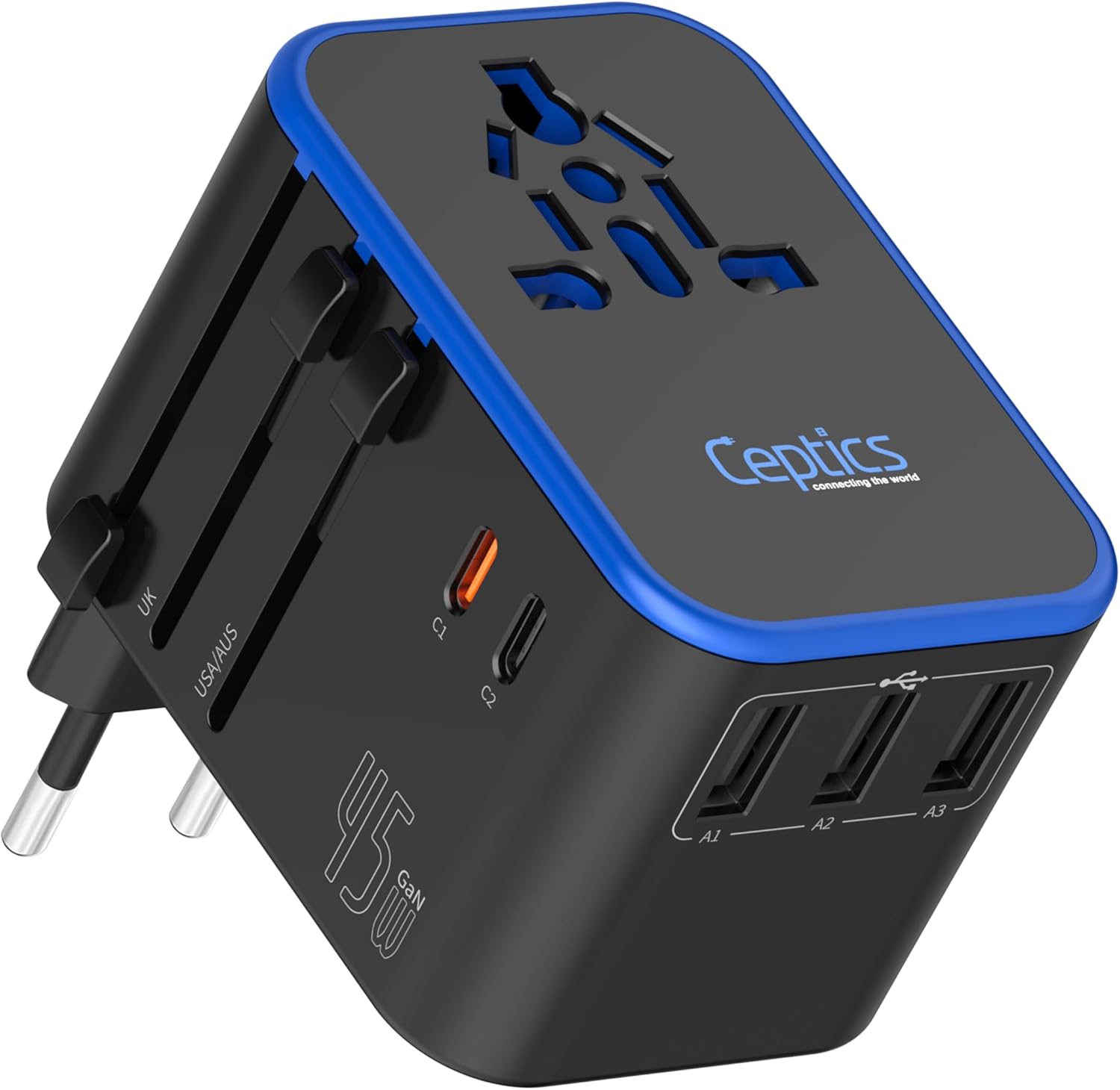
Ceptics 45W Universal Travel Adapter (PD & QC 3.0, Dual USB-C)
The do-everything adapter. It covers Type A, C, G, and I plugs (the US, Europe, UK, Australia and 200+ countries), and its 45W Power Delivery output is fast enough to charge a laptop directly — something most travel adapters cannot do.
Best for: Travelers visiting multiple countries who want one adapter that handles everything
- ✓ 45W USB-C Power Delivery — fast enough to charge most laptops
- ✓ Dual USB-C plus three additional USB ports for charging many devices at once
- ✓ Covers Type A / C / G / I plugs — works in 200+ countries
- ✓ Built-in surge protection to safeguard your electronics
Quick Global Summary: Plugs, Voltage & Adapter Needs by Region
Before diving into individual countries, here is the broad picture. Nine travel regions cover almost every destination. "Sometimes" in the converter column means a converter is needed only for single-voltage devices (hair dryers, curling irons, older appliances) — not for modern electronics.
| Region | Main Plug Types | Voltage | Frequency | US Adapter Needed? | Converter Needed? |
|---|---|---|---|---|---|
| North America | A, B | 120V | 60Hz | No | No |
| Continental Europe | C, E, F | 220–230V | 50Hz | Yes | Sometimes (hair tools only) |
| UK & Ireland | G | 230V | 50Hz | Yes | Sometimes (hair tools only) |
| East Asia (China, Korea, HK) | A, C, G, I | 220–230V | 50Hz | Sometimes | Sometimes |
| Japan | A, B | 100V | 50/60Hz | No | Rarely (100V is safe for most dual-voltage devices) |
| Southeast Asia | A, B, C, G | 220–240V | 50Hz | Sometimes | Sometimes |
| Australia & New Zealand | I | 230V | 50Hz | Yes | Sometimes |
| South America | A, B, C, I, N | 110–220V | 50–60Hz | Sometimes | Sometimes |
| Africa | C, D, G, M | 220–240V | 50Hz | Yes | Sometimes |
| Middle East | C, G | 220–240V | 50Hz | Yes | Sometimes |
The 15 World Plug Types: A Through O Explained
The International Electrotechnical Commission (IEC) has catalogued 15 plug and socket types, labelled A through O. This proliferation exists because electrical infrastructure was built independently by each country during the late 19th and early 20th centuries — by the time international standardisation was attempted, too much infrastructure was in place to change cheaply. The result: 15 incompatible systems that travelers must navigate.
Here are all 15 types, where they are used, the voltage they serve, and what you need to know about each:
| Type | Pin Configuration | Where Used | Voltage | Key Facts |
|---|---|---|---|---|
| A | 2 flat parallel blades | USA, Canada, Mexico, Japan, Central America, Caribbean | 100–127V | Most common type in North America. Ungrounded (no earth pin). No protection against reversed polarity. |
| B | 2 flat blades + round earth pin | USA, Canada, Mexico (with Type A) | 120V | Grounded version of Type A. Increasingly standard in US construction but often found alongside ungrounded Type A outlets. |
| C | 2 round pins | Most of Europe, South America, Asia, Africa, Middle East | 220–240V | The most widespread plug type in the world. Works in all Type E and F sockets. Sometimes called the "Europlug." |
| D | 3 large round pins in triangle | India, Nepal, Sri Lanka | 230V | A uniquely Indian design. Older large-pin version (BS 546). Many Indian sockets also accept Type C. |
| E | 2 round pins + socket hole | France, Belgium, Poland, Czech Republic, Slovakia | 230V | Similar to Type C but includes a round earth pin protruding from the socket. Type C plugs work in Type E sockets. |
| F | 2 round pins + 2 side earth clips | Germany, Austria, Netherlands, most of Continental Europe | 230V | Also called "Schuko" (from German Schutzkontakt). Type C plugs work in Type F sockets. Most common grounded plug in Europe. |
| G | 3 rectangular blades in triangle | UK, Ireland, Hong Kong, Singapore, Malaysia, UAE, Kenya, Cyprus | 230V | The largest and safest common plug design — mandatory fuse in the plug provides device-level protection. Completely incompatible with other European types. |
| H | 3 pins in Y-shape | Israel only | 230V | Found only in Israel. A newer round-pin version (SI 32) is also used. Most modern electronics still fit using a Type C adapter. |
| I | 3 flat pins in V-shape | Australia, New Zealand, Argentina, Papua New Guinea | 230V | Also used in China, though China has its own version. Argentina's Type I is slightly different from Australia's — check carefully. |
| J | 3 round pins | Switzerland, Liechtenstein | 230V | Switzerland's unique plug. Type C plugs fit in Swiss sockets (with care), but not all Type J sockets accept Type C — a universal or dedicated adapter is safer. |
| K | 2 round pins + U-shaped earth | Denmark, Greenland, Faroe Islands | 230V | Denmark's own standard alongside the common C/F types. Type C and F plugs typically work in Danish sockets. |
| L | 3 round pins in line | Italy, Chile, older North African installations | 230V | Italy uses three variants of Type L at different current ratings. The 10A and 16A versions look similar. Type C plugs usually fit the 10A version. |
| M | 3 large round pins in triangle | South Africa, Swaziland (large version of Type D) | 230V | Similar to Type D but with larger pins. South Africa also uses Type N and Type C in newer installations. |
| N | 3 round pins (IEC standard) | Brazil, South Africa (newer) | 100–240V | Brazil's official standard since 2013. The first plug type designed from the start by the IEC as a universal standard. |
| O | 3 round pins in triangle | Thailand (official standard) | 220V | Thailand's official plug since 2012, though older Type A, B, and C outlets remain common. Universal adapters cover Thailand. |
Voltage & Frequency: The Two Global Standards
Every country in the world uses one of two voltage systems, and one of two frequencies. Understanding both prevents damage to electronics and equipment.
110–127V systems (North America, Japan, parts of South America and Central America): Lower voltage, generally considered slightly safer for direct contact. The US, Canada, and Mexico use 120V at 60Hz. Japan uses 100V — the lowest standard voltage in the world — at 50Hz in eastern Japan and 60Hz in western Japan. This quirk means a device bought in eastern Japan may run slightly out of spec in western Japan.
220–240V systems (most of the world): Higher voltage delivers more power with thinner wires — more efficient for national grid infrastructure, which is why most countries that electrified after the 1950s adopted it. The EU standardised at 230V (with a tolerance that encompasses the old 220V and 240V standards). Running a 110V-only device at 240V without a converter will destroy it immediately.
Frequency — 50Hz vs 60Hz: North America, parts of South America, and portions of Japan use 60Hz. Most of the world uses 50Hz. For most modern electronics (phones, laptops, cameras) this difference is irrelevant — their power supplies handle both automatically. Equipment with motors (blenders, some electric clocks, older fans) may run at slightly different speeds or overheat. Heating elements (hair dryers, ovens) are less sensitive to frequency but very sensitive to voltage.
Dual-Voltage vs Single-Voltage: What Your Device Label Tells You
The most important check before any international trip is reading the small print on every device you plan to bring. The label is usually on the device's underside, the power brick, or the charger itself.
Dual-voltage (safe worldwide): If the label reads "Input: 100-240V" or "Input: 110-240V", the device works on any electrical system in the world — you only need an adapter to change the plug shape. The vast majority of modern consumer electronics fall into this category.
Single-voltage (requires a converter or stays home): If the label reads "Input: 110V", "120V", or "220V" only, the device is designed for one voltage system. Taking a 120V-only device to a 230V country without a voltage converter will permanently damage it.
| Device | Usually Dual-Voltage? | Adapter Only? | Converter Needed? | Notes |
|---|---|---|---|---|
| Smartphone charger | Yes — almost always | Yes | No | Check label to confirm. All major brands (Apple, Samsung, Google) are dual-voltage. |
| Laptop power adapter | Yes — almost always | Yes | No | Modern laptop bricks explicitly state 100-240V. Verify on older models. |
| Tablet charger | Yes — almost always | Yes | No | Same as smartphone chargers. |
| Camera battery charger | Yes — usually | Yes | No | Most modern camera chargers (Canon, Nikon, Sony) are dual-voltage. |
| Electric toothbrush charger | Yes — usually | Check label | Rarely | Most Oral-B and Sonicare chargers are dual-voltage, but verify. |
| CPAP machine (travel models) | Yes — travel models | Yes | No | Travel CPAPs are designed for worldwide use. Standard home CPAPs often are not. |
| Power bank | Yes — always | Yes | No | Power banks charge from USB — no voltage conversion needed at all. |
| Hair dryer (full-size) | No — usually single-voltage | No | Yes (or buy travel version) | Most full-size hair dryers are 110V only. Using abroad without a converter is a fire risk. |
| Curling iron / flat iron | No — usually single-voltage | No | Yes (or buy dual-voltage travel tool) | Same caution as hair dryers. Many brands sell dedicated dual-voltage travel versions. |
| Electric shaver (older models) | No — sometimes single-voltage | Check label | Sometimes | Modern Braun and Philips shavers are typically dual-voltage. Check older models. |
| Kitchen appliances (US) | No — single-voltage | No | Do not bring abroad | Blenders, toasters, coffee makers are built for one voltage system. Leave them home. |
| Alarm clock (plug-in) | Sometimes | Check label | Sometimes | Simple clocks may use a motor calibrated to 60Hz — it may run slow at 50Hz. |
Best Travel Adapters for Europe (Type C)
Heading to Italy, Spain, France, Germany, Portugal, Iceland, or almost anywhere in continental Europe? You need a Type C adapter. Since nearly every modern phone, laptop, and camera charger is already dual-voltage, a simple Type C adapter with built-in USB ports is all most European trips require. These are our favourites.

TESSAN European Travel Plug Adapter (2-Pack, 4 Outlets + 3 USB incl. USB-C PD 20W)
Italy, Spain, France, Portugal, Iceland, Germany
A genuine travel essential for Europe. Each adapter expands one European socket into four outlets and three USB ports, so the whole family can charge from a single wall plug. The 20W USB-C PD port fast-charges a phone.
- ✓ Two adapters in the pack — one per traveler or room
- ✓ 4 AC outlets + 3 USB ports (incl. 20W USB-C Power Delivery)
- ✓ Ideal for hotel rooms with only one accessible socket
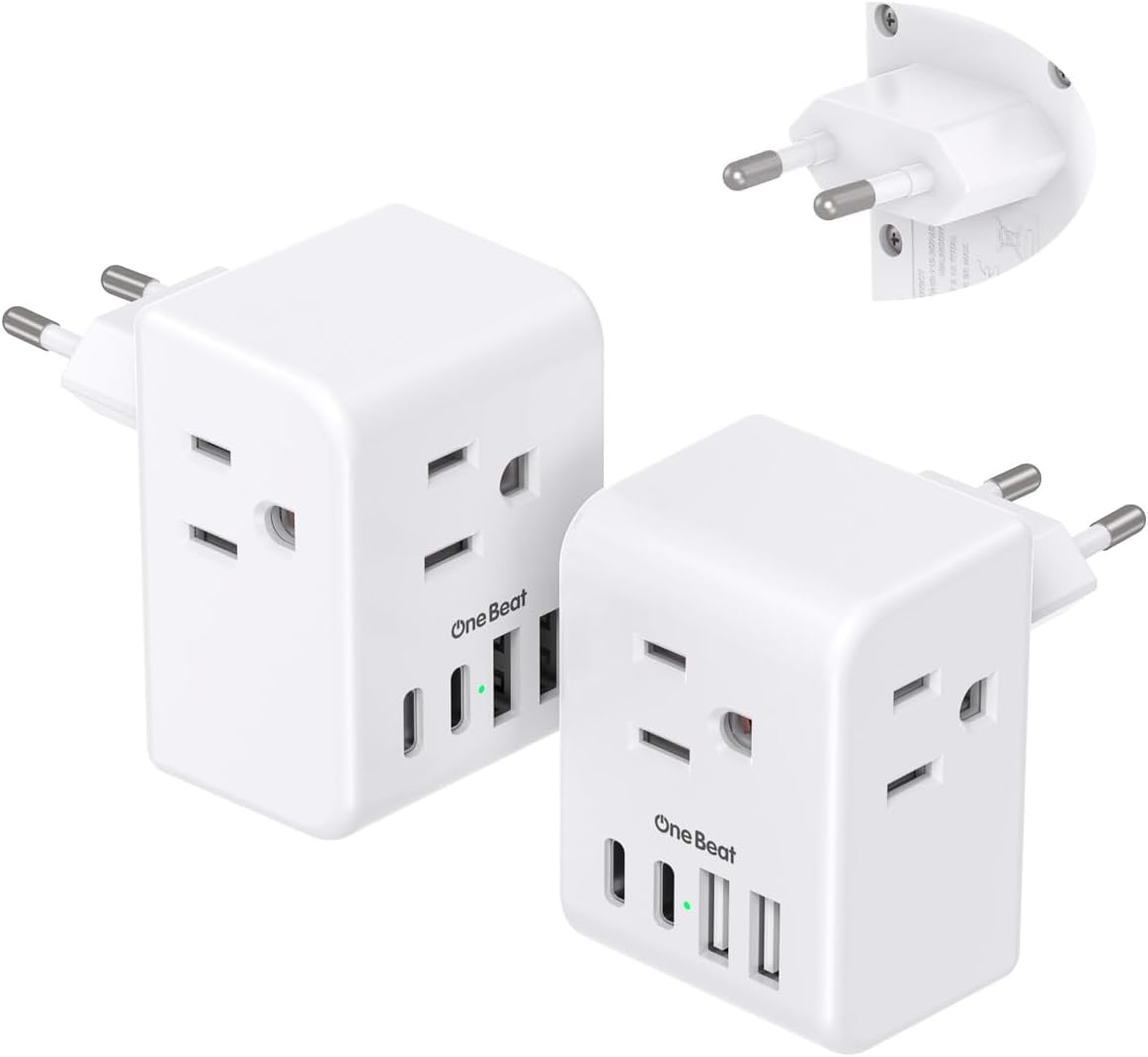
International Power Plug Adapter (2-Pack, 3 Outlets + 4 USB incl. 2 USB-C)
Spain, Italy, France, Germany & most of Europe
With four USB ports (two of them USB-C) plus three AC outlets, this is the pick if you travel with a lot of gadgets — phones, watch, earbuds, tablet, and camera can all charge simultaneously.
- ✓ Four USB ports including two USB-C
- ✓ Three AC outlets for chargers and small electronics
- ✓ Two-pack — keep one in each bag

VINTAR European Travel Plug Adapter (2-Pack, Foldable, 2 Outlets + 3 USB incl. 2 USB-C)
Minimalist & carry-on-only travelers
Folding pins make this the most pocketable option here — it disappears into a daypack or jacket pocket. Still packs two AC outlets and three USB ports (two USB-C) despite the small footprint.
- ✓ Foldable pins for truly compact packing
- ✓ 2 AC outlets + 3 USB ports (2 USB-C)
- ✓ Lightweight two-pack

Unidapt US to Europe Plug Adapter (4-Pack, Type C)
Groups, families & spares for every bag
No USB ports, no frills — just four simple, reliable Type C plug adapters at the lowest cost per unit. Perfect for handing one to each member of a group or stashing spares in every bag.
- ✓ Four adapters in the pack — lowest cost per unit
- ✓ Tiny and light — toss one in every bag
- ✓ Simplest possible US-to-Europe plug conversion
Best Universal Travel Adapters (Worldwide)
If your trip spans multiple regions — or you simply want one adapter to keep forever — a universal model is the smart buy. These cover the US, Europe, UK, and Australia plug types in a single unit. Our top overall pick (the Ceptics 45W, above) leads this category; here are three more excellent universal options.
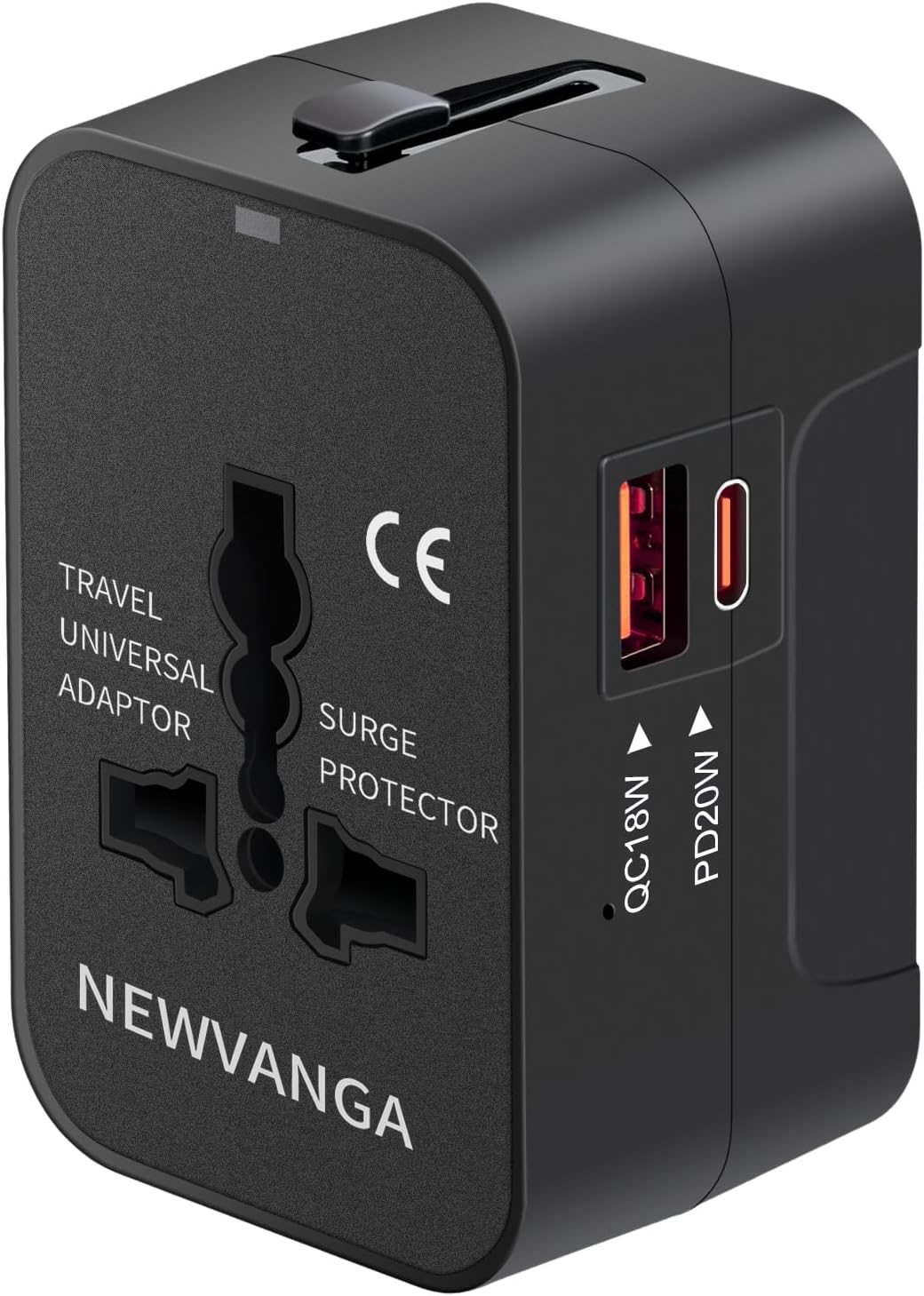
Universal Travel Adapter, GaN PD 3.0 (USB-C + USB-A Quick Charge, USA/EU/UK/AUS)
Tech travelers who want the fastest charging
Modern GaN (gallium nitride) technology means this all-in-one runs cooler and charges faster than older adapters, while staying compact. Covers USA, EU, UK, and Australia plugs with fast USB-C PD output.
- ✓ GaN PD 3.0 for fast, cool, efficient charging
- ✓ USB-C and USB-A quick-charge ports
- ✓ Single unit covers USA / EU / UK / AUS
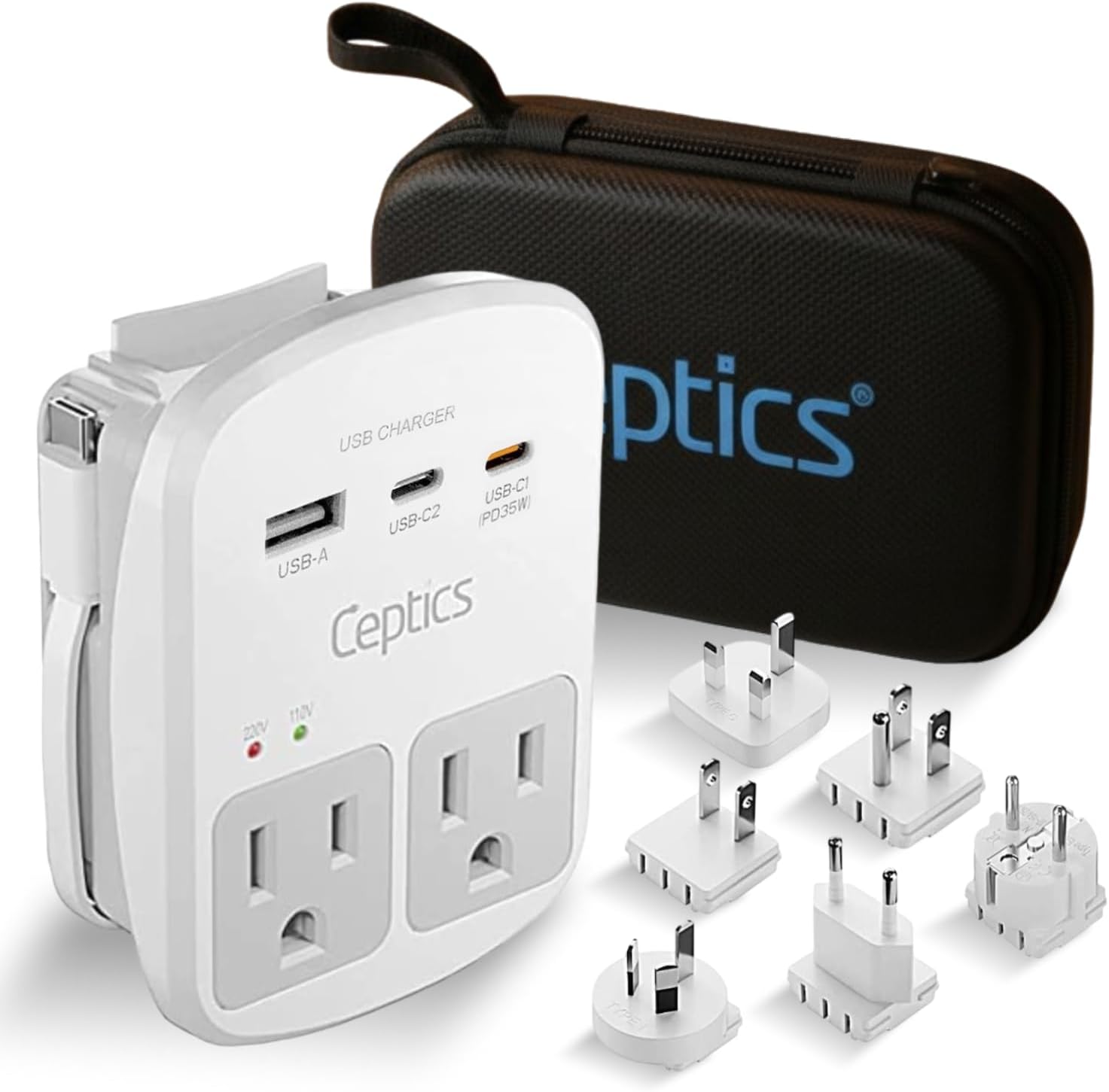
Ceptics 35W Universal Travel Adapter Kit (2 USA sockets, USB-C PD + USB-C Cable)
Travelers who want a complete, surge-protected kit
A complete travel-charging kit: 35W USB-C PD, two USA sockets, USB-A, an included USB-C cable, and surge protection. ETL-tested and ideal for charging a laptop, phone, and camera together.
- ✓ 35W USB-C Power Delivery + included USB-C cable
- ✓ Two USA sockets plus USB-A — surge protected
- ✓ Plugs for EU, UK, China, AU, and Japan; ETL tested

Universal Travel Adapter, 2x USB-C (PD 20W) + USB-A, 224+ Countries
Light packers who still want worldwide coverage
An all-in-one that slides the four major plug types out of a single compact body, with two 20W USB-C PD ports and a USB-A. Covers 224+ countries — a great everyday carry for frequent flyers.
- ✓ Two 20W USB-C PD ports + USB-A
- ✓ All-in-one body — slide out USA / EU / UK / AUS pins
- ✓ Works in 224+ countries
Best Adapter for the UK & Ireland (Type G)
Important: the UK and Ireland do NOT use the same plug as continental Europe. They use the chunky Type G three-pin plug — also used in Dubai, Hong Kong, Singapore, and Kenya. If your trip is only to the UK or Ireland, this dedicated adapter is the right choice.
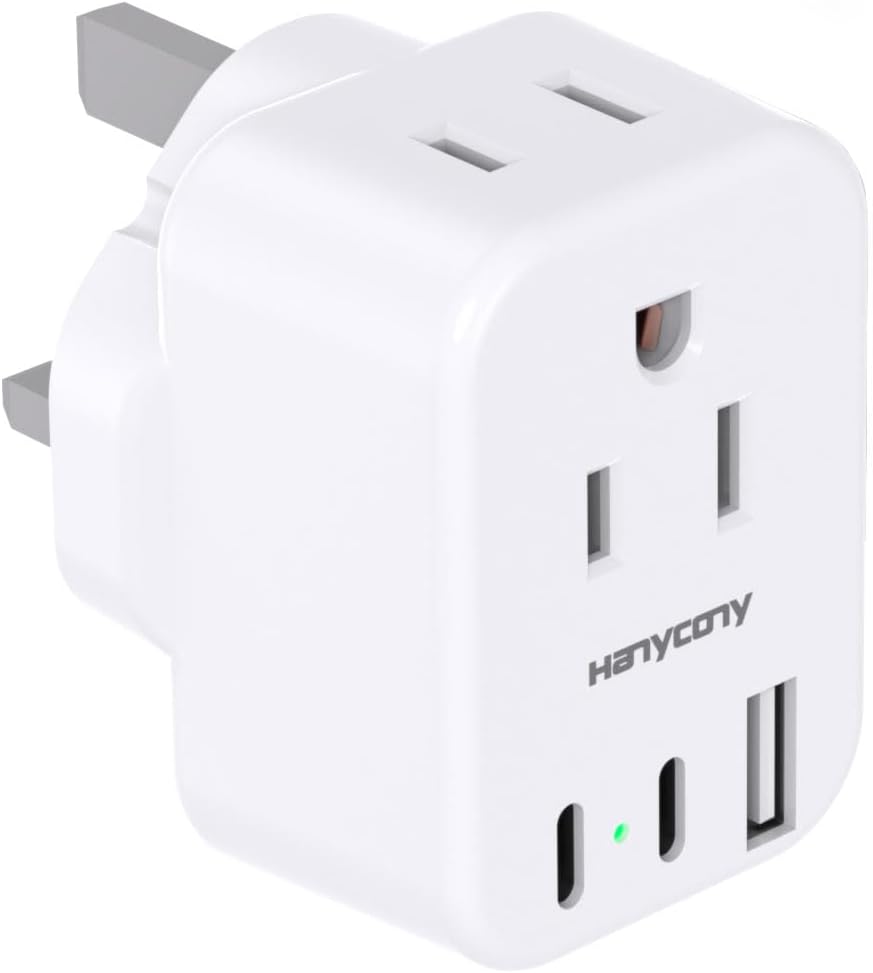
HANYCONY US to UK Travel Plug Adapter (Type G, 2 Outlets + 3 USB incl. 2 USB-C)
England, Scotland, Ireland, Dubai, Hong Kong
A dedicated Type G adapter that turns one UK socket into two AC outlets and three USB ports (two USB-C). The right tool for London, Edinburgh, Dublin, and the other Type G destinations.
- ✓ 2 AC outlets + 3 USB ports (2 USB-C)
- ✓ Correct Type G plug for UK / Ireland / Dubai / Hong Kong
- ✓ Charges multiple devices from one wall socket
📶 Don't Forget Mobile Data
A travel adapter keeps your devices charged — a travel eSIM keeps them connected. Get data in 200+ countries the moment you land, with no roaming bills.
Get a Travel eSIM with Yesim →Affiliate link — we may earn a small commission at no extra cost to you.
Visiting the USA from Europe? (Reverse Adapter)
Travelling the other way — from Europe to the United States, Canada, or Mexico? You need a reverse adapter that fits European Type C plugs into North American Type A sockets. Remember that the US runs on 120V, so confirm your devices are dual-voltage (100-240V) before plugging in.

Unidapt European to US Plug Adapter (EU to USA, Type A, 2-Pack)
European travelers visiting the US, Canada or Mexico
The adapter Europeans need for North America — converts your European Type C plug to fit US/Canada/Mexico Type A sockets. A simple, reliable two-pack so you always have a spare.
- ✓ Converts EU Type C plugs to US Type A sockets
- ✓ Works in the USA, Canada, and Mexico
- ✓ Two-pack — keep one as a backup
Country-by-Country Plug & Voltage Reference (60+ Countries)
This table covers the most-visited travel destinations. "Adapter from US" means a traveler with US devices needs a physical plug adapter. "Converter needed" refers to single-voltage appliances only — for modern electronics (phones, laptops, tablets), the answer is almost always No.
| Country | Plug Type(s) | Voltage | Frequency | Adapter from US? | Converter Needed? |
|---|---|---|---|---|---|
| United States | A, B | 120V | 60Hz | No | No |
| Canada | A, B | 120V | 60Hz | No | No |
| Mexico | A, B | 127V | 60Hz | No | Rarely |
| France | C, E | 230V | 50Hz | Yes | Sometimes (hair tools) |
| Germany | C, F | 230V | 50Hz | Yes | Sometimes (hair tools) |
| Spain | C, F | 230V | 50Hz | Yes | Sometimes (hair tools) |
| Italy | C, F, L | 230V | 50Hz | Yes | Sometimes (hair tools) |
| Portugal | C, F | 230V | 50Hz | Yes | Sometimes (hair tools) |
| Greece | C, F | 230V | 50Hz | Yes | Sometimes (hair tools) |
| Netherlands | C, F | 230V | 50Hz | Yes | Sometimes (hair tools) |
| Belgium | C, E | 230V | 50Hz | Yes | Sometimes (hair tools) |
| Switzerland | C, J | 230V | 50Hz | Yes | Sometimes (hair tools) |
| Austria | C, F | 230V | 50Hz | Yes | Sometimes (hair tools) |
| Denmark | C, E, F, K | 230V | 50Hz | Yes | Sometimes (hair tools) |
| Norway | C, F | 230V | 50Hz | Yes | Sometimes (hair tools) |
| Sweden | C, F | 230V | 50Hz | Yes | Sometimes (hair tools) |
| Finland | C, F | 230V | 50Hz | Yes | Sometimes (hair tools) |
| Iceland | C, F | 230V | 50Hz | Yes | Sometimes (hair tools) |
| Czech Republic | C, E | 230V | 50Hz | Yes | Sometimes (hair tools) |
| Poland | C, E | 230V | 50Hz | Yes | Sometimes (hair tools) |
| Croatia | C, F | 230V | 50Hz | Yes | Sometimes (hair tools) |
| Hungary | C, F | 230V | 50Hz | Yes | Sometimes (hair tools) |
| United Kingdom | G | 230V | 50Hz | Yes | Sometimes (hair tools) |
| Ireland | G | 230V | 50Hz | Yes | Sometimes (hair tools) |
| Japan | A, B | 100V | 50/60Hz | No | Rarely (100V is safe for most dual-voltage devices) |
| China | A, C, I | 220V | 50Hz | Sometimes | Sometimes (hair tools) |
| South Korea | C, F | 220V | 60Hz | Yes | Sometimes (hair tools) |
| Hong Kong | G | 220V | 50Hz | Yes | Sometimes (hair tools) |
| Taiwan | A, B | 110V | 60Hz | No | Rarely |
| Singapore | G | 230V | 50Hz | Yes | Sometimes (hair tools) |
| Malaysia | G | 240V | 50Hz | Yes | Sometimes (hair tools) |
| Thailand | A, B, C | 220V | 50Hz | Sometimes | Sometimes (hair tools) |
| Vietnam | A, C, D | 220V | 50Hz | Sometimes | Sometimes (hair tools) |
| Indonesia (Bali) | C, F | 230V | 50Hz | Yes | Sometimes (hair tools) |
| Philippines | A, B, C | 220V | 60Hz | Sometimes | Sometimes (hair tools) |
| India | C, D, M | 230V | 50Hz | Yes | Sometimes (hair tools) |
| Nepal | C, D | 230V | 50Hz | Yes | Sometimes (hair tools) |
| Sri Lanka | D, G | 230V | 50Hz | Yes | Sometimes (hair tools) |
| Australia | I | 230V | 50Hz | Yes | Sometimes (hair tools) |
| New Zealand | I | 230V | 50Hz | Yes | Sometimes (hair tools) |
| UAE (Dubai) | G | 230V | 50Hz | Yes | Sometimes (hair tools) |
| Saudi Arabia | A, B, G | 127/220V | 60Hz | Sometimes | Sometimes |
| Turkey | C, F | 230V | 50Hz | Yes | Sometimes (hair tools) |
| Israel | C, H | 230V | 50Hz | Yes | Sometimes (hair tools) |
| Egypt | C, F | 220V | 50Hz | Yes | Sometimes (hair tools) |
| Morocco | C, E | 220V | 50Hz | Yes | Sometimes (hair tools) |
| South Africa | C, M, N | 230V | 50Hz | Yes | Sometimes (hair tools) |
| Kenya | G | 240V | 50Hz | Yes | Sometimes (hair tools) |
| Nigeria | D, G | 240V | 50Hz | Yes | Sometimes (hair tools) |
| Tanzania | D, G | 230V | 50Hz | Yes | Sometimes (hair tools) |
| Brazil | C, N | 127/220V | 60Hz | Yes | Sometimes (varies by city) |
| Argentina | C, I | 220V | 50Hz | Yes | Sometimes (hair tools) |
| Chile | C, L | 220V | 50Hz | Yes | Sometimes (hair tools) |
| Colombia | A, B | 120V | 60Hz | No | No |
| Peru | A, B, C | 220V | 60Hz | Sometimes | Sometimes (hair tools) |
| Costa Rica | A, B | 120V | 60Hz | No | No |
| Cuba | A, B, C | 110/220V | 60Hz | Sometimes | Sometimes |
| Russia | C, F | 230V | 50Hz | Yes | Sometimes (hair tools) |
| Jordan | C, D, F, G | 230V | 50Hz | Yes | Sometimes (hair tools) |
| Maldives | G | 230V | 50Hz | Yes | Sometimes (hair tools) |
| Cambodia | A, C, G | 230V | 50Hz | Sometimes | Sometimes (hair tools) |
Adapter vs Converter: A Clear Side-by-Side Comparison
This is the most important distinction in international power. Getting it wrong is expensive. Here is the complete breakdown:
| Feature | Plug Adapter | Voltage Converter |
|---|---|---|
| What it does | Changes plug shape only. No electrical conversion. | Steps voltage up or down (e.g. 230V → 110V). |
| Does it change voltage? | No | Yes |
| Typical cost | $10–35 | $30–100+ |
| Typical weight | Light (under 100g) | Heavy (transformer-based, 500g–1kg+) |
| Who needs it? | Everyone traveling internationally with electronics | Only travelers with single-voltage appliances (older hair dryers, curling irons, some kitchen appliances) |
| Safe for phones? | Yes — with a dual-voltage (100-240V) charger | Not needed |
| Safe for laptops? | Yes — virtually all laptop chargers are dual-voltage | Not needed |
| Safe for hair dryers? | Only if the dryer is dual-voltage | Yes — if wattage-rated correctly |
| Key check | Look for "Input: 100-240V" on device label | Wattage of converter must exceed wattage of device |
Keep reading
 Airport Security & Carry-On RulesBreeze through security by knowing the rules
 Baggage Size & Weight Limits50+ airlines compared — exact carry-on dimensions, checked bag weight limits, overweight fees, and how to avoid every extra charge
 Travel Packing ListEverything you need (and nothing you don't) for any trip
Do You Need a Voltage Converter? Four Common Scenarios
The question of whether you need a voltage converter can be resolved in three steps. Most travelers — even on long international trips — do not need one at all. Work through these scenarios:
Find the small label on each device or its power adapter. If it reads "Input: 100-240V" (or similar), you are done — that device is dual-voltage and needs only a plug adapter. If it reads "110V" or "120V" only, continue to Step 2.
Option A: Leave the device at home and use the hotel's equivalent (most hotels provide hair dryers). Option B: Buy a dual-voltage travel version of the appliance (widely available for hair tools, about $30-60). Option C: Buy a voltage converter ($30-100+) rated higher than the wattage of your device — but converters are heavy, expensive, and should not be used continuously for more than 1-2 hours.
Hair dryers and straighteners are typically 1200-2000W — far too powerful for most voltage converters to handle safely for extended periods. Even properly matched converters can overheat with high-wattage heating elements. The practical solution: leave hair tools home, use hotel hairdryers, or invest in a dual-voltage travel version (they exist for every major brand).
Converters are rated for maximum wattage — never exceed this rating or daisy-chain multiple devices. Do not use converters with heating elements for more than 60-90 minutes continuously. Never use a converter to power another converter. Quality matters: buy from established brands with certified safety ratings (ETL, UL, CE).
Europe-Specific Plug Rules: Three Zones, One Common Trap
"I'm going to Europe — what adapter do I need?" is one of the most common travel questions, and the answer has a crucial trap: Europe is not one plug system. It is three.
Continental Europe (most countries): Type C/E/F plugs, 230V. This covers France, Germany, Spain, Italy, Portugal, Netherlands, Belgium, Greece, Croatia, Czech Republic, Poland, Hungary, and most other EU countries. A Type C adapter (two round pins) works in virtually all of these.
UK and Ireland: Type G plugs, 230V. This is completely incompatible with the continental European plug. A Type C adapter will not fit a UK socket and vice versa. If your trip includes London, Edinburgh, or Dublin alongside Paris or Rome, you need either two separate adapters or a universal adapter covering both.
Switzerland and Liechtenstein: Type J plugs. Similar to Type C but with a recessed socket profile. Type C plugs usually fit in Swiss sockets but not always — a Swiss-specific or universal adapter is more reliable.
Italy exception: Italy uses three variants of Type L alongside Types C and F. In older Italian buildings you may encounter the older large-pin Type L sockets (16A) where standard Type C plugs will not fit. Modern hotels almost always have Type F sockets that accept Type C. If you are staying in an old building or villa, a universal adapter covers this edge case.
- Traveling only to Continental Europe (no UK/Ireland): A Type C adapter is all you need.
- Including the UK or Ireland: Either buy a Type G adapter in addition, or buy one universal adapter that covers both.
- Multi-device setup (charging many things at once): Choose a Type C adapter with multiple USB ports rather than buying multiple adapters.
- Long-stay or slow travel in Europe: Consider a quality universal adapter and a small power strip — one plug, six outlets, zero complications.
- Warning: Airport kiosk and hotel gift shop adapters are often overpriced and poorly made. Buy a quality adapter before you travel.
How to Choose the Right Adapter
Use the region and country tables above. One country with Type C? A simple Europe adapter is cheapest. UK or Ireland only? You need Type G. Multiple regions? Buy universal. Visiting all three (continental Europe, UK, and Australia/NZ on the same trip)? A universal adapter that covers A, C, G, and I is the only clean solution.
Traveling with just a phone? A simple adapter works. Traveling with a phone, laptop, tablet, earbuds, camera, and watch? Choose an adapter with multiple USB ports (at minimum two USB-C and two USB-A). Running on one outlet in a European hotel room with three travelers? A multi-outlet adapter with USB ports is essential.
Check every charger and appliance for "100-240V" on the label. Modern phones, laptops, tablets, and cameras almost universally qualify. Full-size hair dryers, curling irons, and most kitchen appliances typically do not. Make this check a non-negotiable part of packing.
If you want to charge a laptop directly from the adapter's USB-C port (bypassing the laptop's own charger), look for a minimum of 45W USB-C Power Delivery — our top pick delivers exactly this. For phones and tablets only, 20W PD is plenty. Below 20W, fast charging will not activate on modern phones.
How to Travel Without Power Problems: 6 Practical Tips
Find every device and charger you plan to bring. Read every label. Separate them into "dual-voltage — adapter only" and "single-voltage — decide what to do." This 10-minute exercise prevents 100% of voltage-related disasters.
A travel adapter with multiple USB ports expands one foreign socket into a charging hub for all your devices. For longer trips or multi-device travelers, a small, lightweight power strip (with USB ports and a universal input) means you only need one adapter for everything.
Converters are heavy, expensive, and only necessary for a narrow range of appliances. For hair care: use hotel hair dryers (available in virtually every hotel worldwide) or invest in a dual-voltage travel hair dryer or straightener. Buying a quality dual-voltage travel version pays for itself on one trip by avoiding converter headaches.
High-end hotels often have universal sockets in rooms. Contact your hotel and ask before you pack heavy converters. Many European hotels now provide UK-to-EU adapters at reception. Short-term rentals and hostels are less predictable — always bring your own adapter.
On active travel days — hiking, long tours, beach days — a high-capacity power bank keeps all USB devices charged without needing a socket at all. Note: airlines restrict batteries over 100Wh (roughly 27,000mAh) in carry-on luggage, and prohibit them in checked bags. A 20,000mAh power bank at 3.6V nominal ≈ 72Wh — well within limits.
Week before: audit all devices for voltage, confirm adapter type for destination, check power bank charge. Day of travel: pack adapter(s), pack power bank in carry-on (not checked), pack cables for every device. Arrival: locate sockets in room, set up charging hub, confirm adapter fits before plugging in high-wattage devices.
Quick Destination Reference
- Europe (excl. UK): Type C/F plug, 230V — all modern electronics work with a Type C adapter.
- UK & Ireland: Type G plug, 230V — you need a specific UK adapter, not the continental European one.
- USA & Canada: Type A/B plug, 120V — electronics from these regions need a step-up converter in Europe.
- Australia & New Zealand: Type I plug, 230V — most electronics work fine with a Type I adapter.
- Japan: Type A plug, 100V — most modern dual-voltage electronics handle 100V; confirm before you plug in.
- India: Type D plug (plus C and M), 230V — a multi-region or universal adapter covers most situations.
- Southeast Asia: Mix of C, F, and G — a universal adapter is the safest choice.
- South America: Mostly C/F (like Europe), but Argentina uses Type I — check your specific country.
- Middle East (UAE): Type G — the same as the UK.
Frequently Asked Questions
Do I need a voltage converter for international travel?
For most travelers, no. The vast majority of modern electronics — phones, laptops, tablets, cameras, and their chargers — are dual-voltage (labeled "Input: 100-240V") and work worldwide with only a plug adapter. You only need a voltage converter if you are bringing a single-voltage appliance (typically hair dryers, curling irons, or older kitchen appliances labeled "120V" or "110V" only) to a country with a different voltage standard. Check every device label before you pack.
Will my phone charger work abroad?
Almost certainly yes. Every major smartphone charger sold in the past decade — Apple, Samsung, Google, OnePlus, and all others — is dual-voltage and explicitly rated "Input: 100-240V." This means the charger works on any electrical system in the world. All you need is a plug adapter to physically connect it to the foreign socket. Confirm by checking the small print on your charger brick before you travel.
Is a travel adapter enough, or do I need a converter?
A plug adapter is enough for all dual-voltage devices (those labeled 100-240V). A voltage converter is additionally required only for single-voltage devices taken to a region with a different voltage — for example, taking a US 120V-only hair dryer to 230V Europe. The simple test: check your device label. "100-240V" means adapter only. "110V" or "120V" only means you need a converter too, or a better option is to leave the appliance home and use the hotel's or buy a travel-specific dual-voltage version.
What happens if I plug a device into the wrong voltage?
Plugging a 110V-only device into a 230V socket (without a proper converter) will almost certainly permanently destroy the device — the excess voltage burns out the motor, heating element, or circuitry. In some cases it can cause sparks, smoke, or a small fire. The reverse (plugging a 230V device into a 120V socket) usually just means the device runs slowly, quietly, or not at all — less dangerous but potentially damaging over time. Always check the voltage label before plugging in any device you are unsure about.
Can I use a US plug in Europe?
Not directly — US Type A/B plugs do not fit European Type C/E/F sockets. You need a Type C adapter (round two-pin) for continental Europe, or a Type G adapter for the UK and Ireland. The good news is that your US electronics almost certainly run on "Input: 100-240V", meaning they are electrically compatible with European 230V — the adapter simply lets the US plug physically connect to the European socket without any voltage conversion needed.
What's the difference between Type C, E, and F plugs in Europe?
Type C is the two-round-pin plug (called the Europlug) — it fits in both Type E and Type F sockets, making it the universal workaround across continental Europe. Type E sockets (used mainly in France, Belgium, and Poland) have a round socket hole and a protruding earth pin from the socket itself. Type F sockets (used in Germany, Austria, the Netherlands, Spain, and most of Europe) have two round holes and grounding clips on the sides. In practice, a standard Type C plug from a smartphone or laptop charger works in virtually every continental European socket. Most modern travel adapters use a Type C plug for this reason.
Do I need different adapters for different European countries?
For most of continental Europe, no — one Type C adapter works in France, Germany, Spain, Italy, Portugal, Netherlands, Greece, and most other EU countries. The major exception is the UK and Ireland, which use Type G (three rectangular pins) — completely incompatible with Type C. Switzerland uses Type J (slightly different from Type C but usually accepts Type C plugs). If your European trip includes both the UK and the continent, either bring two adapters or buy one universal adapter that covers both Type C and Type G.
Are universal travel adapters worth it?
For multi-destination travelers or anyone who travels internationally more than once or twice a year, yes — a good universal adapter (covering Type A, C, G, and I) eliminates the need to ever research plug types again and is the last adapter you will need to buy. For a single trip to one plug region (for example, just continental Europe), a cheaper region-specific adapter is more cost-effective. The key is buying quality: certified adapters with surge protection from established brands protect expensive electronics; uncertified cheap adapters can overheat and cause real damage.

About the author
SK Kutubuddin · Founder & Editor
The founder and editor of Travel and Time. An aeronautical engineer with close to two decades in aviation, I build the site’s flight, distance, and trip-planning tools myself and check every figure before it goes live. I write from Kolkata, India.
More about author →